

What Size Fence Can I Put Up? UK Fence Height Rules Explained

The size fence you can put up in the UK without planning permission is capped at 2 metres at rear and side boundaries, and just 1 metre where the fence faces a road, footpath or highway. These limits come from permitted development rights and apply to most residential properties in England and Wales.
Going beyond those heights is not automatically forbidden, but it does require approval from your local planning authority. Materials, trellis toppers and even decorative finials all count toward the total measurement, which catches many homeowners off guard during installation.
The rules also shift depending on whether the boundary is at the front, rear or side of the property, and listed buildings or conservation areas tighten them further. The sections below break down each scenario, including neighbour disputes, legal trellis additions, and what happens if a fence breaches the cap.
Maximum Fence Height You Can Put Up Without Planning Permission (UK)
Permitted development rights in England and Wales allow a fence up to 2 metres (≈6ft 7in) at rear and side boundaries, and up to 1 metre (≈3ft 3in) where the fence borders a road, public footpath or highway. Anything above these thresholds requires planning permission from your local council.
Height is measured from the natural ground level on the higher side of the fence. That measurement includes everything attached to the structure: trellis toppers, post caps, finials and decorative tops. So a 1.8m panel with a 30cm trellis is treated as a 2.1m fence and breaches the cap.
Permitted development rights also disappear in several common cases. Listed buildings, properties inside conservation areas, Areas of Outstanding Natural Beauty (AONB) and homes under an Article 4 direction typically face stricter thresholds, and some require consent for any fence at all. Always check with your local planning authority before ordering materials.
Scotland applies similar 2m and 1m thresholds, with applications handled through ePlanning Scotland under the Town and Country Planning (Scotland) Act. Northern Ireland follows comparable rules administered via the Planning Portal NI, although exact wording and exceptions differ.
If your project sits close to these limits, confirm the boundary line on your title plan first, since small measurement errors at ground level can push a compliant fence into breach territory.
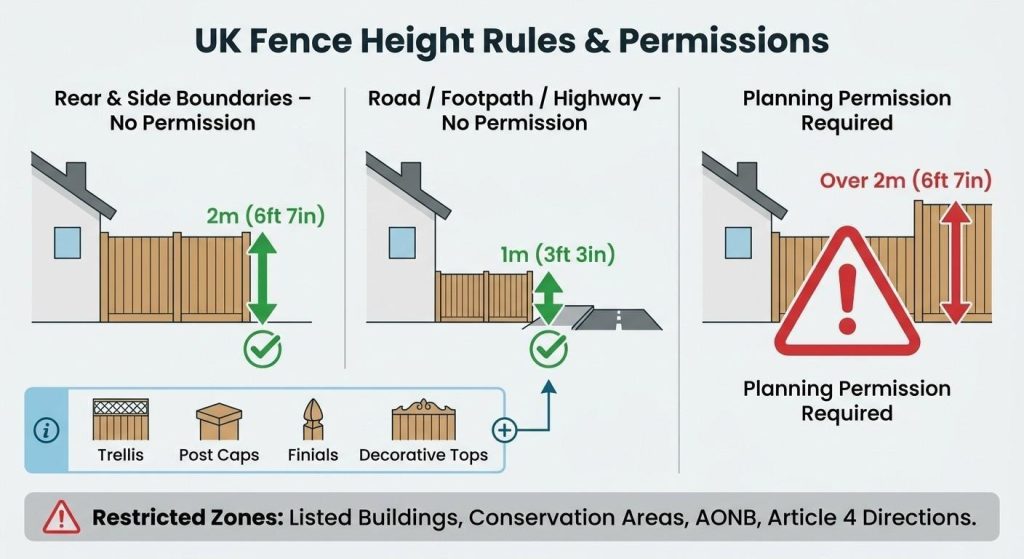
UK fence height rules infographic showing 2m permitted height at rear and side boundaries versus 1m limit at road and footpath boundaries, with planning permission required above these thresholds
Front Garden Fence Height: Can You Put Up a 6ft Fence at the Front?
No, a 6ft (1.83m) front garden fence is not permitted without planning permission. The cap drops to 1m (≈3ft 3in) wherever the boundary sits next to a highway, road or public footpath, so any front-facing fence above that needs council approval.
The 1m rule exists primarily for road safety. Drivers reversing off driveways need clear sightlines, pedestrians must remain visible at junctions, and councils enforce these visibility standards under the Highways Act 1980. A taller barrier creates blind spots and increases collision risk.
“Adjacent to a highway” covers more than the road surface itself. It also includes pavements, grass verges, shared access lanes and unadopted streets used by vehicles, which catches most front gardens in residential areas.
If you want extra privacy at the front, several legal routes work:
- Apply for planning permission through the Planning Portal if a taller solid fence is essential.
- Plant a hedge such as laurel, yew or hornbeam, since hedges fall outside fence rules and only trigger the High Hedges Act once a 2m evergreen screen attracts a complaint.
- Combine a 1m solid base with open trellis, where the council accepts it as decorative rather than structural.
For low front fences, charred timber cladding is a popular finish because the carbonised surface weatherproofs the wood and adds depth without breaching the 1m cap.
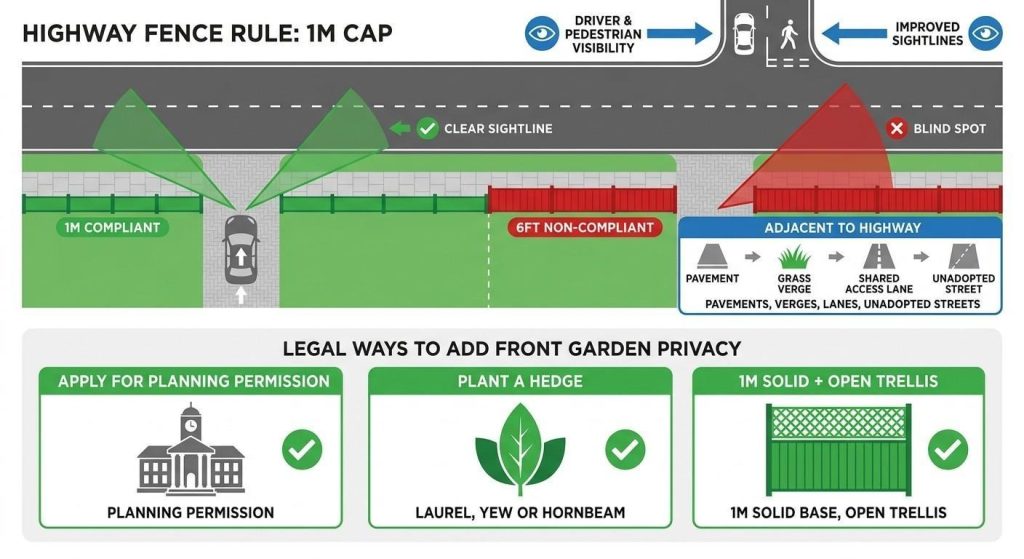
Front garden fence height limit UK infographic showing 1m maximum height rule near roads and driveways, road safety sightline diagram, and three legal alternatives for front garden privacy
Can My Neighbour Put Up an 8ft Fence?
Not legally, unless they have planning permission. At roughly 2.44m, an 8ft fence sits well above the 2m permitted-development cap for rear and side boundaries, so council approval is mandatory before installation.
Taller fences do exist legally in a few situations. Some predate current planning rules and are effectively grandfathered, others have been granted planning permission after a householder application, and a few sit on raised ground or retaining walls that lift the overall height past 2m without breaching the rules as measured from the higher side.
If a neighbour erects an 8ft fence without permission, enforcement is complaint-driven rather than proactive. You report the breach to your local planning authority’s enforcement team, who investigate and decide whether action is justified.
Likely outcomes include an enforcement notice ordering the fence to be reduced to 2m, an invitation to submit a retrospective planning application, or, if notices are ignored, prosecution and fines. Most cases resolve at the notice stage.
Ownership is a separate question. T-marks on the Land Registry title plan indicate which side is responsible for maintaining the boundary, but they don’t override planning rules. The Party Wall Act 1996 covers shared walls and excavations, not standard timber fence panels, so it offers no remedy for a fence dispute.
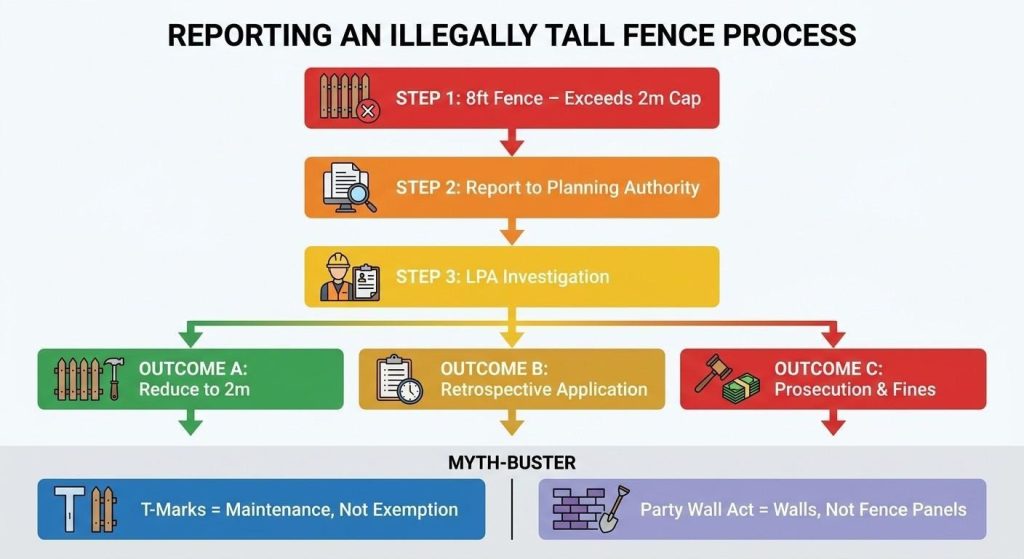
Flowchart showing how to report a neighbour’s illegally tall fence in the UK, enforcement process steps, and three possible outcomes including enforcement notice, retrospective planning permission and prosecution
How to Legally Increase the Height of an Existing Fence (Trellis, Lattice & More)
Trellis counts towards the total fence height under permitted development, so a 1.8m fence topped with a 30cm trellis is treated as 2.1m and breaches the 2m cap. The material of the topper does not matter; the council measures the overall structure from ground level.
Some local authorities take a softer view of open-lattice trellis used purely as a frame for climbing plants, but interpretations vary. Always confirm with your local planning department before fitting any topper.
If you need more privacy without breaching the limit, several legal alternatives work well:
- Evergreen hedges such as laurel, yew or hornbeam, which can grow up to 2m without notification (taller hedges fall under the High Hedges Act 2003)
- Raised planters filled with tall ornamental grasses or bamboo set behind the fence line
- Pleached trees set back from the boundary, since trees are not classed as fencing
Raising the ground level is not a loophole. Piling soil against a fence to gain height is treated as part of the fence by most councils, therefore the added soil counts towards the 2m cap.
For anything above 2m, submit a householder application through the Planning Portal. The fee is around £258 in 2026, and decisions typically take eight weeks, depending on the council’s design and amenity policies.
If the goal is purely visual, charred timber fencing refresh an existing structure with a weatherproof, modern finish without altering its legal height.
What Size Fence Can I Put Up: FAQ
Can I Put Up a 7ft Fence in the UK?
A 7ft fence (≈2.13m) exceeds the 2m permitted-development cap, so planning permission is required even at a rear boundary. Approval depends on the council’s local plan, neighbour consultation, and whether the proposed design preserves visual amenity and daylight for adjoining properties. Conservation areas and Article 4 zones face stricter scrutiny.
Can I Put Up a 2m Fence Next to My Neighbour’s Garden?
Yes, 2m is the maximum permitted height at side and rear boundaries without planning permission, provided the fence sits entirely on your land. Neighbour consent is not legally required, although you should consider impacts on light and access. Notifying them in advance prevents disputes and keeps the boundary relationship amicable.
Does Trellis Count Towards Fence Height in the UK?
Yes, trellis is included in the total height calculation under permitted development, so a 1.8m fence with a 30cm topper measures 2.1m and breaches the cap. Some councils make exceptions for open lattice grown with climbers, but interpretation varies. Always verify with the local planning department before installing.
What Happens if I Build a Fence Higher Than 2m Without Permission?
Enforcement is complaint-led: a neighbour or passer-by reports the breach, and the local planning authority investigates. The council may issue an enforcement notice requiring the fence to be reduced, or accept a retrospective planning application. Ignoring the notice can lead to fines and, in rare cases, prosecution.
Choosing a fence that respects UK height rules does not mean compromising on style or longevity. At TimberSol, we craft charred timber panels using the traditional Yakisugi technique, delivering boundaries that pair compliant 1.8m and 2m heights with weather-resistant, strikingly modern surfaces.
Browse our charred fencing collection to find panels engineered for British gardens, or speak to our team for bespoke sizing that keeps your project well within permitted development limits.
Liora Skye, founder of Magazinevalve, is a certified SEO professional and skilled writer with over 5.5 years of experience. She specializes in creating authentic, engaging, and well-researched celebrity blogs that connect with readers worldwide


