

Ring of Barahir: The Heirloom That Outlived Two Ages of Middle-earth

Most readers can recite the One Ring’s properties from memory. Black Speech inscription. Smooth gold band. Invisibility. Far fewer can name the ring that traveled longer through Tolkien’s timeline. The Ring of Barahir — two serpents twined under a crown of golden flowers — moved through six thousand fictional years before reaching Aragorn’s hand in The Fellowship of the Ring. It predates Sauron’s forge. It predates the Shire. It predates Aragorn’s own bloodline by twenty generations. And Tolkien never gave it a chapter. The full story sits in footnotes, an Appendix, and a single chapter of The Silmarillion that most LOTR readers skip entirely.
What the Ring of Barahir Actually Is
Tolkien describes the Ring of Barahir as twined gold shaped into “two serpents with eyes of emerald, and their heads met beneath a crown of golden flowers, which the one upheld and the other devoured.” That’s the entire physical description. No size given. No inscription. No magical property assigned.
Compared to the One Ring’s elaborate Black Speech engraving and invisibility power, the Ring of Barahir does nothing. It just exists. The serpents come from heraldry — they represent the House of Finarfin, the Elven royal line of Nargothrond. The crown of golden flowers references the bloom-laden meadows that gave Finrod his crown. The fact that one serpent supports the crown while the other devours it is the whole symbol: hunger and protection, threat and loyalty, sitting in tension on the same band. Most modern jewelers miss this asymmetry entirely.
The First Owner Wasn’t Aragorn
The ring’s first wearer was Finrod Felagund, an Elven king. He gave it to Barahir, a mortal man, after Barahir saved his life during the Battle of Sudden Flame in the First Age. That’s the moment the ring becomes an heirloom — not because Finrod handed it down to his own family, but because he gave it to a man whose bloodline he barely knew. The covenant was simple: in any future hour of need, the holder of this ring could call on the House of Finarfin for aid.
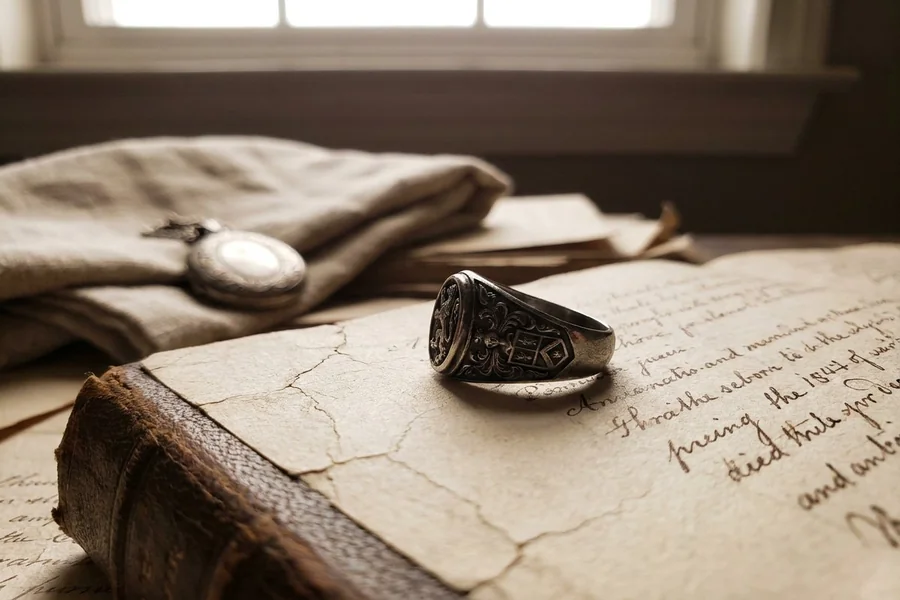
An heirloom isn’t built — it’s worn until the patina, scratches, and slight band stretch tell their own story.
Barahir died wearing it. His son Beren reclaimed it from orcs who had cut off Barahir’s hand — a scene Tolkien dispatches in less than half a page. Beren then carried it through his quest for the Silmaril, eventually using it as proof of identity when meeting Lúthien’s father. After Beren, the ring passed to his son Dior, then to Elwing, to Eärendil, and across twenty more generations of mixed Elven and Mannish descendants — including the Kings of Númenor and, eventually, the Northern Dúnedain. Aragorn inherited it through that chain. Finrod first gave it to Barahir in the winter of First Age year 455,, roughly six thousand years before the events of The Lord of the Rings.
Promise vs. Power — How Barahir’s Ring Is the Anti-One Ring
The contrast with the One Ring is deliberate. Sauron forged the One Ring as a tool of domination. Its power scaled with corruption, and its inscription bound other rings to his will. Barahir’s ring does the opposite. It makes a promise, holds it across generations, and demands nothing from whoever wears it.
Tolkien — a Catholic and a philologist — wove this distinction into the deeper structure of his legendarium. Power objects in Middle-earth tend to corrupt their owners. Heirloom objects tend to protect them. This one falls firmly in the second category. That’s why no character in the books or films ever struggles to give it away or wears it past its purpose. When Aragorn finally hands it to Arwen as a betrothal token, he isn’t sacrificing power. He’s completing a covenant that began before the kingdoms of Men were even named.
The Engagement Ring Argument
This handoff is where Barahir’s ring collides with modern men’s jewelry conversations. In the appendix titled “The Tale of Aragorn and Arwen,” Tolkien describes the betrothal at Cerin Amroth. Aragorn places the ring on Arwen’s finger. She accepts. They are pledged. That single line reframed how a generation of Tolkien readers thought about engagement rings — not as diamonds bought new, but as objects with a history before the couple ever met.
Specialty jewelers who handle medieval-style pieces report a steady demand from couples wanting that “passed down” aesthetic without an actual family heirloom to inherit. Stores like Bikerringshop, which carry medieval-style sterling silver rings drawing on heraldic, signet, and crusader-era traditions, see the request often: a ring that looks as if it has already lived a hundred years. The catch — and the reason most fan replicas miss the mark — is that an heirloom isn’t manufactured. It’s worn until the patina, scratches, and slight band stretch tell their own story. A new ring that mimics an heirloom only becomes one over the next thirty years. Tolkien understood this. Barahir’s ring means something because it was already old when Aragorn was born.
Why Real-World Replicas Got the Snakes Wrong
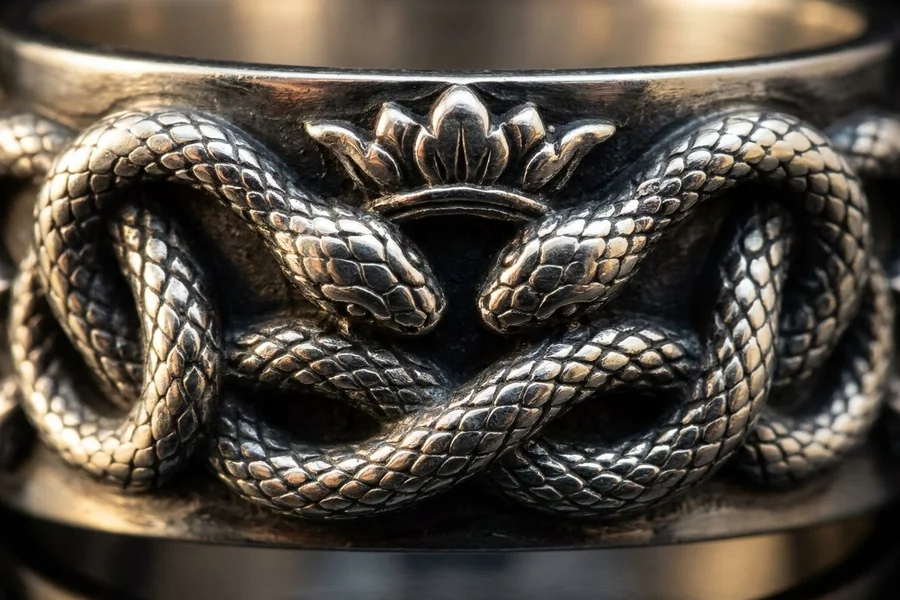
The asymmetry between the two serpents is the symbolism. A perfectly mirrored snake-pair flattens the meaning into decoration.
Peter Jackson’s film prop, made by New Zealand jeweler Jens Hansen and his workshop, took liberties with Tolkien’s text. The screen ring shows two serpents in roughly opposing positions, but the crown of golden flowers is barely visible — and the “one upheld, one devoured” tension is gone. Hansen’s team made a similar simplification when crafting the One Ring (smooth band, no script visible without firelight). Both decisions were practical: prop rings need to read clearly on camera, and the original Tolkien description would clutter at film distance.
The result is that nearly every Etsy and prop-shop replica copies the film version, not the book. Purist jewelers who work directly from The Silmarillion’s text instead of from movie stills tend to produce rings that look stranger and more asymmetrical — which is, oddly, closer to what Tolkien actually wrote. The asymmetry is the symbolism. A perfectly mirrored snake-pair flattens the meaning into decoration. Bikerringshop’s guide to iconic movie rings covers similar prop-vs-book deviations across other film jewelry that fans have built entire collections around.
Frequently Asked Questions
What does the Ring of Barahir symbolize in Tolkien’s writing?
The ring represents a covenant of aid between the Elves of Nargothrond and the bloodline of Barahir. The two serpents — one supporting and one devouring a crown of golden flowers — embody the tension of protection and threat held in the same promise. It’s a loyalty token, not a power object.
Is the Ring of Barahir based on a real-world artifact?
No verified single source exists, but Tolkien drew on Anglo-Saxon and Norse heirloom-ring traditions. Twin-serpent motifs appear on recovered Viking-era rings from the British Isles, and the covenant-by-ring concept has roots in Germanic oath-rings (eiðbaugar), which feature heavily in the Icelandic sagas Tolkien studied as a philologist.
How is Barahir’s ring different from the One Ring?
Barahir’s ring holds a promise. The One Ring holds power. The Elven heirloom stays neutral across all twenty-plus owners — it doesn’t corrupt, demand, or seek a master. The One Ring corrupts every owner except hobbits, and even they last only briefly. One protects through memory. The other dominates through hunger.
Why did Aragorn give it to Arwen?
At their betrothal at Cerin Amroth, Aragorn pledged himself to Arwen with the heirloom as the token. Tolkien framed it as the closing moment of a six-thousand-year covenant — the ring finally returning, in a sense, to the Elven line it came from when Finrod first gave it to Barahir. As an engagement ring, it has the longest fictional provenance in literature.
Most rings in fantasy literature exist to be destroyed, hidden, or wielded. Tolkien’s smallest piece of jewelry exists to be passed down. It is also his most patient — surviving wars, betrayals, the sinking of Númenor, and an entire age that ended with most of its kingdoms in ruin. When Arwen finally received it, the ring had been worn by mortals for longer than any human civilization has existed in real life. That is the heirloom argument, condensed into one small object.
Liam Carver has worked with heirloom-style and medieval-inspired men’s jewelry for over fifteen years, focusing on signet rings, sterling silver heirloom commissions, and historical motif design. He curates handcrafted pieces at Bikerringshop.
Liora Skye, founder of Magazinevalve, is a certified SEO professional and skilled writer with over 5.5 years of experience. She specializes in creating authentic, engaging, and well-researched celebrity blogs that connect with readers worldwide


