

Grid Bots vs DCA Bots: Which Fits a Choppy 2026 Market?

When the market moves sideways and then breaks sharply, traders often face a practical question: should they use a grid bot, a DCA bot, or a combination of both? This guide explains how each approach works, where each performs best, and what users should consider before choosing a bot strategy.
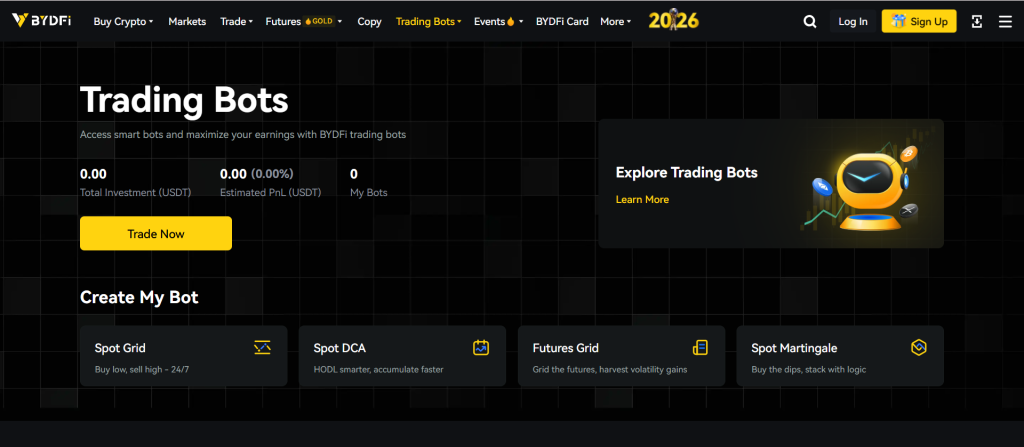
Platforms such as BYDFi make this comparison easier by combining Spot Grid, Spot DCA, Futures Grid, demo trading and Bot Marketplace tools in one trading environment. That allows traders to review strategy types, test configurations and compare automation methods before using real funds in live markets.
How Grid Bots and DCA Bots Actually Work
A Spot Grid bot carves a user-defined price range into multiple grid levels, placing buy orders at lower grids and sell orders at higher ones. Each time price bounces between adjacent levels, the bot aims to capture small price differences — an automated tool designed to respond to range-bound price movement.
A Spot DCA bot makes periodic fixed-amount purchases — daily, weekly, or monthly — accumulating an asset regardless of short-term price action. The goal is to reduce the average entry price over time, not from swing trades.
Futures Grid applies grid logic to leveraged perpetual contracts for greater capital efficiency.
The core distinction? Grid bots harvest volatility within a range. DCA bots average cost over time.
Grid Bots vs DCA Bots: Head-to-Head Comparison
| Criterion | Spot Grid Bot | DCA Bot |
| Ideal market condition | Sideways / range-bound | Downtrend / uncertain |
| Core mechanic | Buy low, sell high within range | Fixed-amount periodic buys |
| Profit source | Repeated swing captures | Lower average cost over time |
| Time horizon | Short-to-medium term | Medium-to-long term |
| Setup complexity | Moderate (range + grid count) | Low (amount + interval) |
| Liquidation risk (spot) | None | None |
| Uptrend limitation | Stops capturing above upper bound | Buys at rising prices (higher avg cost) |
| Customization | Up to 99 grid levels, TP/SL | Adjustable anytime |
Step 1: Match the Bot to Your Market Read
Grid bots thrive in choppy, range-bound conditions — capturing repeated oscillations that generate near-zero returns for buy-and-hold. DCA bots serve as disciplined accumulation tools for uncertain or declining markets, mathematically pulling average cost lower as price falls — though recovery isn’t guaranteed.
Grid bot weakness in sustained uptrends: once price breaks above the upper bound, the bot stops capturing upside. A Futures Grid bot with an upward-biased range can stay directionally long using leverage, but risk controls are especially important when leverage is used.
Practical tip: Review the pair’s recent price range and volatility before setting a grid strategy. If price has bounced between two levels multiple times, that’s grid territory. Trending down or genuinely unsure? DCA is the safer structural choice.
Step 2: Factor in Fees and Capital Efficiency
Grid bots execute many small trades. Tighter grids mean more transactions and more cumulative fee drag. Calculate expected profit per grid level against round-trip fee impact — if per-grid profit barely exceeds fees, margins evaporate. On platforms applying standard maker/taker fees without a separate bot premium, the math stays the same as manual trading, but you must verify per-grid profit exceeds round-trip cost.
DCA bots execute fewer scheduled trades, so cumulative fees stay lower and capital deploys incrementally rather than getting locked across a range.
Futures Grid options offer leverage for higher capital efficiency, but liquidation risk scales accordingly — so users should evaluate margin settings carefully before deployment.
Step 3: Set Up Your Bot — Concrete Configuration Tips
Grid bot setup requires four decisions: price range (upper/lower bounds), grid levels (up to 99), total investment, and optional TP/SL thresholds — noticeably more parameters than a DCA bot, which needs only asset selection, purchase amount, and interval.
AI-assisted grid setup tools may help users generate initial parameters based on historical market data — useful for getting started without hours of chart analysis.
The full suite of BYDFi bots for grid and DCA strategies supports AI-assisted setup, a bot marketplace with community-shared configurations and historical performance data, and one-click deployment — making it straightforward to start with either method
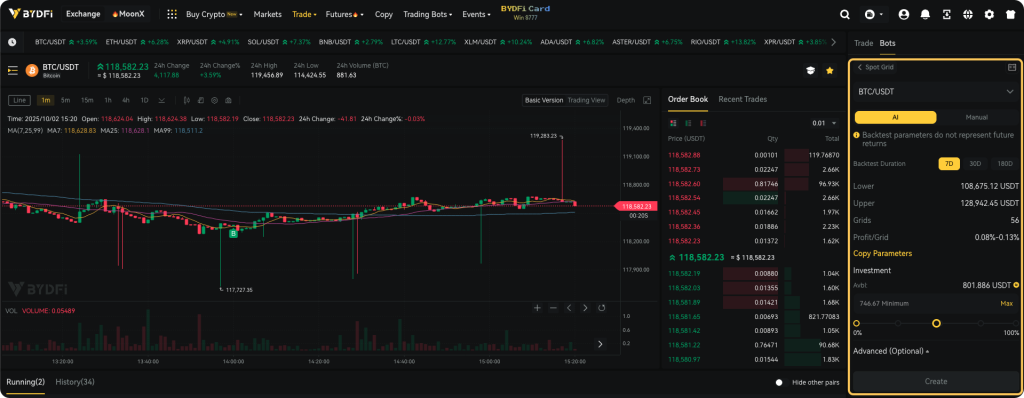
DCA strategies can typically bemodified anytime. Some platforms support multiple simultaneous bots per pair, letting you test several range hypotheses in parallel.
Step 4: Manage Risk and Test Before Committing Capital
Spot bots (both Grid and DCA) operate within your spot balance with no forced liquidation. Futures Grid carries leveraged liquidation risk.
Grid bot–specific risk: price dropping below your range leaves you holding assets at a loss; breaking above means missed upside. DCA-specific risk: prolonged downtrends can leave accumulated positions underwater with no guaranteed recovery.
Before deploying real capital, use demo or paper-trading accounts. BYDFi includes a demo account preloaded with 50,000 USDT in simulated funds, letting you test bot configurations on mobile or desktop before using real funds in live markets.
Best practice: test on a single pair first, monitor weekly, adjust grid range as conditions evolve.
Step 5: Combine Strategies for Broader Coverage
Running both strategies diversifies your automated approach across market regimes. Deploy a Spot Grid bot on a range-bound large-cap pair (BTC/USDT or ETH/USDT) while DCA-ing into a high-conviction altcoin for long-term accumulation.
Bot marketplaces letting you browse community strategies filtered by pair, timeframe, and historical return help source configuration ideas. Spreading capital across approaches can help users manage exposure across different market scenarios.
Common Mistakes to Avoid
- Grid range too narrow: Frequent stop-outs. Too wide: capital spreads thin with tiny per-grid profit.
- Ignoring fee math: Tight grids with standard fees erode margins. Always calculate net profit per grid level.
- DCA without an exit plan: Accumulation without a take-profit target is incomplete.
- Futures Grid without understanding liquidation: Higher efficiency comes with higher liquidation risk.
- Skipping demo testing: Validate parameters in demo mode before using real funds.
- “Set and forget” mentality: Markets shift. Monitor weekly and adjust.
Which Bot Suits You? A Decision Guide
Range-bound trader / short-term focus: Spot Grid — captures oscillations in sideways markets.
Long-term accumulator / uncertain outlook: Spot DCA — disciplines buying, lowers average cost, removes emotion.
Experienced / capital-efficiency-focused trader: Futures Grid — leveraged grid trading for those who accept liquidation risk.
Beginner unsure where to start: Look for AI-recommended grid parameters or community bot marketplaces with transparent performance histories. BYDFi’s demo mode is a practical starting point — while live deployment should be gradual and based on the user’s risk tolerance.
The Trade-Off Summary
Choosing between grid bots and DCA bots in a choppy 2026 market isn’t about crowning a universal winner.
Two risks to weigh: Grid bots can leave you holding underwater assets if price breaks below your range. DCA bots can accumulate losing positions for months during prolonged downtrends, tying up capital with no guaranteed recovery.
Two advantages to capture: Grid bots grab small gains from sideways oscillations — though results depend on configuration, fees, and whether price stays in range. DCA bots enforce disciplined buying that may benefit from mean-reversion dynamics over longer periods while removing the psychological burden of timing entries.
The right choice depends on your market read, time horizon, and configuration effort. For many traders, running both simultaneously across different pairs is the most pragmatic answer.
Liora Skye, founder of Magazinevalve, is a certified SEO professional and skilled writer with over 5.5 years of experience. She specializes in creating authentic, engaging, and well-researched celebrity blogs that connect with readers worldwide


